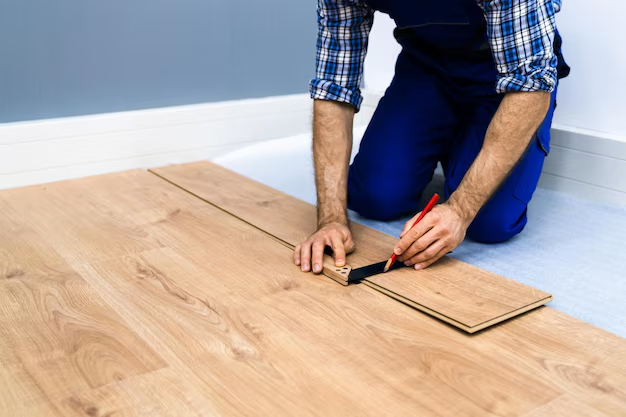
How To Install Laminate Flooring Step by Step: A Practical Guide
Laminate flooring is popular because it’s durable, affordable, and DIY‑friendly. Installing it yourself can save a lot of money—if you understand the process and the details that can trip people up.
This guide walks through how to install laminate flooring step by step, explains where the steps can vary, and helps you understand what you’d need to check for your specific room, house, and skill level.
What Is Laminate Flooring and How Does It Work?
Laminate flooring is a man‑made flooring made of multiple layers:
- Wear layer: Clear, tough surface that resists scratches and stains
- Design layer: Printed image that looks like wood, stone, or tile
- Core layer: High‑density fiberboard (HDF) that gives the plank strength
- Backing layer: Helps with stability and moisture resistance
Most modern laminate uses a floating floor system:
- Planks lock together with a click‑lock edge
- The floor “floats” over the subfloor instead of being nailed or glued down
- A gap around the walls lets it expand and contract with temperature and humidity
Those basics explain why certain steps—like expansion gaps and underlayment—aren’t optional details but part of how the whole system works.
Before You Start: Key Decisions That Affect the Steps
Even the best step‑by‑step guide needs a few decisions up front. These choices change how you install your floor:
1. Type of Subfloor
Your subfloor is what’s under your old flooring:
- Concrete slab
- Wood subfloor (plywood/OSB)
- Existing flooring (vinyl, tile, older laminate, etc.)
This matters because:
- Concrete usually needs a vapor barrier
- Uneven wood may need sanding, shimming, or patching
- Some existing floors are okay to install over, some aren’t (more on that below)
2. Room Conditions and Use
Different rooms create different challenges:
- Basements: More moisture risk; vapor barrier and moisture checks are important
- Kitchens/hallways/entryways: More traffic, more dirt and water; careful sealing around edges matters
- Bathrooms/laundry rooms: Many laminate products are not recommended here unless labeled as water-resistant or suitable for wet areas
Manufacturers usually spell out where their product can and can’t be installed. That affects where you use it and how carefully you handle moisture details.
3. Underlayment Needs
Underlayment is the thin layer under a floating floor. It can provide:
- Cushion
- Sound reduction
- Moisture protection (some types)
You’ll see three main situations:
| Situation | Underlayment Setup | Key Notes |
|---|---|---|
| Laminate with attached pad | Often needs only a separate vapor barrier on concrete | Don’t double-up soft padding unless the manufacturer allows it |
| Laminate without pad, over wood | Use a foam or combo underlayment | Focus on cushion and minor leveling |
| Laminate without pad, over concrete | Use vapor barrier + underlayment, or a combo underlayment rated for concrete | Helps protect against moisture wicking up from slab |
The package and installation instructions usually say exactly what they expect you to use underneath.
Tools and Materials You’ll Typically Need 🛠️
You can adjust this list based on your specific room and product, but most DIY installs use:
Tools:
- Tape measure
- Pencil and straight edge
- Utility knife
- Circular saw, jigsaw, miter saw, or laminate cutter
- Pull bar and tapping block (often sold as a laminate install kit)
- Spacers (for expansion gaps)
- Rubber mallet or light hammer
- Level or long straight board to check flatness
- Safety glasses and hearing protection
Materials:
- Laminate flooring planks
- Underlayment and/or vapor barrier (if required)
- Tape for underlayment seams (if required)
- Matching transition strips and moldings (for doorways and edges)
- Floor patch or leveling compound (if needed)
- Silicone sealant for certain edges (if manufacturer recommends)
Exact needs depend on your subfloor type, room layout, and product instructions.
Step 1: Measure, Plan, and Acclimate Your Flooring
Measure the Room
You’ll want at least a rough material estimate and a sense of how the planks will lay out:
- Measure the length and width of the room in several places
- Note doorways, closets, and alcoves
- Plan for extra material (many people add a percentage to cover cuts and waste—what’s “enough” depends on room shape, your cutting accuracy, and how complex the layout is)
The more irregular the room, the more offcuts you’ll create.
Decide Which Way the Planks Will Run
Most people run planks parallel to the longest wall or in the direction of natural light, but there’s no single “right” direction.
Variables that affect your choice:
- Room shape: Long, narrow rooms often look better with planks running lengthwise
- Adjacent rooms: Continuing the same direction through multiple rooms looks more seamless
- Subfloor joints: Some instructions recommend running laminate perpendicular to subfloor boards for better stability
You can lay a few pieces on the floor (without locking them together) to visualize.
Acclimate the Flooring
Most laminate manufacturers recommend letting the packages sit in the room for a period of time so they adjust to temperature and humidity.
Typically they’ll specify:
- How long to acclimate (ranges can vary)
- Temperature and humidity ranges for installation
This is one of those areas where the manufacturer’s instructions outrank generic advice.
Step 2: Prepare the Subfloor
Laminate is fairly forgiving, but it still needs a flat, clean, dry base.
Remove Old Flooring (When Needed)
Whether you need to remove the old flooring depends on:
- The type of existing floor (carpet vs tile vs vinyl)
- The thickness and condition
- The manufacturer’s rules
Some common patterns:
- Carpet and padding: Almost always removed
- Loose or damaged vinyl: Usually removed
- Glue-down hardwood: Often removed because of height and adhesion
- Solid, flat tile or vinyl: Sometimes allowed as a base layer if it’s sound, level, and clean
If you keep an existing floor, you still need to meet the flatness and height requirements for the new laminate.
Check for Flatness
Manufacturers often specify that the floor must be flat within a certain tolerance over a set distance.
You can:
- Place a long straight board or level on the floor in different directions
- Look for high spots (rocking or gaps underneath) or low spots
Typical adjustments:
- High spots: Sand or grind them down (on wood)
- Low spots: Fill with a floor leveling compound compatible with your subfloor type
The flatter the floor, the better your planks will lock and the less they’ll flex when walked on.
Clean Thoroughly and Check Moisture
- Vacuum and sweep to remove dust, staples, nails, and debris
- On concrete, many installers also check for moisture using simple tests (like taped‑down plastic) or meters—what’s necessary depends on your building and climate
If moisture is a concern, that will affect whether you use a vapor barrier, and sometimes even whether laminate is appropriate at all for that specific space.
Step 3: Install Underlayment and/or Vapor Barrier
This step varies a lot based on product and subfloor, so the product instructions are your primary guide, but here’s the general idea.
Vapor Barrier on Concrete
For slabs or below‑grade spaces, many laminate systems call for:
- A plastic vapor barrier sheet laid directly on the concrete
- Edges overlapped and taped according to the instructions
- Barrier brought slightly up the wall and trimmed later or held behind baseboards
Some underlayments combine vapor barrier + cushion in one. In that case you typically:
- Roll it out
- Tape the seams
- Follow any printed arrows or layout directions
Foam or Combo Underlayment Over Wood
On wood subfloors, you usually:
- Roll out the foam underlayment
- Butt the edges (or slightly overlap if the product says so)
- Tape seams if required
Underlayment With Attached Pad Planks
If your laminate planks have a built‑in foam pad, you typically:
- Skip an extra foam underlayment
- Still install a separate moisture barrier on concrete if required
The big variable here: double-padding can make the floor too soft and affect locking joints, so most manufacturers warn against adding unnecessary extra foam.
Step 4: Plan Your Layout and Expansion Gaps
Maintain Expansion Gaps Around the Perimeter
Laminate needs room to expand and contract. That’s why:
- You leave a gap along all walls and fixed objects (columns, pipes, cabinets)
- You use spacers between the plank edges and the wall while installing
- You later cover that gap with baseboard or quarter-round molding
The exact gap size is usually provided by the manufacturer, and it may grow slightly for larger rooms.
Check Starting and Ending Row Widths
You rarely want a tiny sliver of flooring on the last row. So before you start:
- Measure the room width
- Divide by the plank width to see what you get for the final row
- If the last row would be very narrow, you can rip (cut) the first row narrower so the first and last rows are more balanced
Some installers aim for a final row at least several inches wide, but what’s acceptable depends on your room and comfort with cutting.
Step 5: Install the First Row
Most click‑lock systems run left to right, starting in a corner, but there are exceptions. Always confirm with the diagram in your instructions.
Cutting the First Planks (If Needed)
- If your starting wall isn’t straight, you might scribe and cut your first row to match its shape
- Make sure any cut edge that goes against the wall remains within the covered expansion zone so small gaps aren’t visible later
Laying the First Row
- Lay the first plank with the tongue or groove side oriented as recommended
- Place spacers between the plank and wall to maintain the expansion gap
- Attach the next plank to the end of the first, usually by:
- Inserting at an angle
- Locking it into place
- Gently tapping with a tapping block if the system calls for it
Continue until you reach the end of the wall.
Cut the Last Piece in the Row
- Measure the distance between the last full plank and the wall (minus the expansion gap)
- Mark that length on a plank
- Cut with your saw of choice, face up or face down as recommended for chip control
- Use the cut-off piece to start the next row if it’s long enough (this helps stagger seams)
Step 6: Stagger Seams and Install Middle Rows
Good laminate layouts avoid long, straight seam lines.
Staggering the End Joints
Most manufacturers want the end joints in adjacent rows offset by a certain minimum distance for strength and appearance. You’ll see requirements like:
- Don’t line up seams in adjacent rows
- Avoid “H” patterns or stair‑step patterns
You can achieve this by:
- Using the cut end of the previous row to start the next row (if long enough)
- Cutting a new plank for the first piece of a row when needed
Clicking Rows Together
With the first row set:
- Attach planks end to end to build the second row loosely next to the first
- Angle the long edge of the new row into the first row’s edge
- Lock it down, sometimes tapping gently as instructed
Where space is tight (against a wall), you may need:
- A pull bar to pull planks into place
- A tapping block to protect the plank edges while you nudge them together
Keep checking:
- Joints are tight with no visible gaps
- Spacers stay in place around the room perimeter
- Seams are nicely staggered
Step 7: Work Around Doors, Corners, and Obstacles
This is where patience matters.
Doorways and Door Jambs
Two common approaches:
Undercut the door jambs
- Use a handsaw or oscillating tool to trim the jamb and casing bottom to the thickness of the laminate plus underlayment
- Slide the plank under the trimmed jamb for a clean look
Cut the planks around the jambs
- Trace the shape
- Carefully cut with a jigsaw
- Leave proper expansion gap, then cover with trim or flexible sealant as recommended
You’ll also need transition strips where laminate meets other flooring types (tile, carpet, vinyl). These typically:
- Snap into a separate track
- Cover the expansion gap at the doorway
Pipes, Vents, and Other Protrusions
For pipes, you often drill a hole slightly larger than the pipe, then cut a small wedge piece out of the plank:
- Lay the plank
- Glue (if allowed) or carefully fit the wedge back in behind the pipe
- Finish with a trim ring or escutcheon
For floor vents, usually:
- Cut openings to fit the vent
- Maintain expansion gap if the vent is fixed, and cover it with the vent cover
Manufacturers often provide specific guidance—and sometimes accessories—for these tricky spots.
Step 8: Install the Last Row
The last row almost always needs lengthwise cutting.
- Measure from the last full row to the wall, subtracting the expansion gap
- Transfer the measurement to your planks
- Cut the planks lengthwise with a circular saw, table saw, or jigsaw
- Fit them into place using a pull bar to click them into the previous row
Again, maintain spacers at the wall to preserve the expansion gap while you work.
Step 9: Add Moldings, Trim, and Final Touches
Once all planks are laid and tight:
- Remove all spacers from the perimeter
- Install baseboards or quarter-round molding to cover the expansion gap:
- Nail or fasten into the wall, not the flooring, so the floor can still move
- Install transition strips in doorways and at flooring changes:
- Follow the specific profile system your brand uses (T‑mold, reducer, end cap, etc.)
- If recommended, apply flexible sealant at edges where moisture could be a concern (e.g., at patio doors or kitchen sink areas)
Check again for:
- Loose pieces
- Gaps in transitions
- Exposed edges without appropriate protection
Common Variations and How They Change the Steps
Not all laminate projects are the same. A few common variations:
1. Wide Open Space vs. Multiple Rooms
- Single large room: Simpler layout, but expansion control is more important
- Several connected rooms: You may need:
- Separate expansion breaks/transition strips between rooms
- Careful planning so plank direction and pattern looks consistent
Manufacturers usually specify how large a continuous area can be before an expansion joint is required.
2. Water-Resistant vs. Standard Laminate
Some newer laminates are designed to resist spills better. They might call for:
- Special edge sealing techniques
- Additional sealant in specific areas
- Requirements about how long water can sit on the surface
Standard laminates are more sensitive to standing water and edge swelling, which affects:
- Where you feel comfortable installing them
- How carefully you treat kitchens, entryways, and near sinks
3. Glue-Assisted Systems
Most modern laminates are fully click‑lock. Some older or specialty systems:
- Use glue in the joints
- Change how you handle working time and clean‑up
If your product requires glue, the manufacturer will specify type, amount, and joint pattern.
Typical Impact: What You Can Expect From a DIY Laminate Install
When installed correctly, laminate flooring can:
- Provide a durable, low‑maintenance surface for many everyday households
- Visually update a room without the cost of solid hardwood
- Be replaced later without major demolition, since it’s a floating system
But outcomes vary based on:
- Subfloor condition – Even small high spots or dips can cause creaks, flexing, or joint failure
- Moisture management – Poor moisture control can cause swelling or buckling
- Accuracy and patience – Rushed cuts and sloppy expansion gaps often show over time
What You’ll Need to Evaluate for Your Own Project
Every home and room is different. To decide how this step‑by‑step process fits your situation, you’d want to look closely at:
Subfloor type and condition
- Concrete vs wood
- Levelness and stability
- Any moisture issues
Room use and environment
- Basement vs main floor
- Exposure to water (kitchens, entries, baths)
- Pets, kids, and traffic levels
Laminate product specifications
- Recommended underlayment and vapor barrier
- Where it can legally/safely be installed (e.g., below grade, in wet rooms)
- Required expansion gap and maximum continuous run size
- Joint staggering rules
Your tools and skill comfort
- Access to saws for precise cuts
- Comfort working around doors and irregular shapes
- Patience for layout planning and detailed work
Once you’ve checked those pieces, you can map this general step‑by‑step laminate flooring installation process onto your own room, adjust for your product’s instructions, and decide what, if anything, might be better handled with additional guidance or professional help.